
DTH Drilling in Hard Rock: 450 ft of Granite, Measured
Most claims about DTH hammer performance in hard rock come from a spec sheet. This one comes from a borehole. In May 2026, a contractor in Julian, California ran a 6″ M60 hammer and a 6¾″ concave bit to 450 ft through medium-hard granite, and we timed every rod on the way down. Below are the penetration rates, the air volumes behind them, the condition of the bit when it came out of the hole, and what all of it means for how you spec tooling on your next hard rock job.
Why Granite Is the Real Test for DTH Tooling
The Julian test site sits in the Peninsular Ranges Batholith, a formation dominated by medium-hard to hard granite and granitic gneiss with unconfined compressive strength typically in the 10,000–18,000 psi range. That is not the hardest rock a drilling contractor will ever see, but it is one of the most punishing on tooling, and for a specific reason: the wear mechanism is abrasion, not just impact.
Dense crystalline rock grinds. Every blow drives carbide into quartz and feldspar, and the cuttings that come back up the hole are themselves abrasive. A bit that survives 450 ft here is doing two things well at once. It is holding gauge against constant lateral abrasion, and it is holding insert integrity against repeated high-energy impact. Failures in this formation usually show up as chipped or lost buttons, flat-spotted gauge rows, or a bit that has quietly drilled itself undersize.
Formation conditions on this run were consistent. No severely fractured zones, no unexpected lithology changes. A minor water influx was encountered, and a small volume of injection water was used to help cuttings evacuation. In short: a clean, representative hard rock run, which is what makes the numbers worth reading.
The Test Configuration
The rig was an Ingersoll-Rand T4W with roughly 2,000 lbs of top head drive weight and compressor capacity up to 900 CFM at 350 psi. Total weight on bit across the run measured approximately 10,000–10,200 lbs, combining the rod string with the top head drive.
| Parameter | Specification |
|---|---|
| Hammer model | Drillian M60 — SKU 330DS06000M6 |
| Hammer OD / length / weight | 5.7 in · 46.7 in (without bit) · 221 lbs |
| Top sub connection | 3½″ API Regular |
| Working pressure range | 145 – 507 psi |
| Bit size / borehole diameter | 6¾ in |
| Shank type | M60 |
| Face type | Concave, 3-port flushing |
| Insert type | Spherical / dome TCI, hot-press, medium hardness |
| Button layout | 9 front + 9 gauge, Ø18 mm — 18 total |
| Total depth | 450 ft (18 rods × 25 ft) |
| String weight | 450 lbs per rod · 8,100 lbs total |
| Casing | PVC |
Full equipment and configuration data as recorded on site, May 26, 2026.
Two details in that table do most of the work. The first is the 5.7 in hammer OD, which is larger than a conventional 5½″ class hammer and accommodates a bigger bore and heavier piston. More piston mass means more energy per blow, and in high-UCS granite blow energy is what governs penetration rate. The second is the dome insert profile. Dome buttons spread impact load across a broader contact area than ballistic or conical shapes, which lowers peak stress at the insert tip — the exact stress that causes chipping in abrasive crystalline rock.
Penetration Rate: What the Rod Timings Showed
Rods 15 through 18 were timed individually, covering the interval from 375 ft to 450 ft. This is deliberately the hardest part of the hole to perform in. Cumulative wear is at its highest, cuttings have the longest distance to travel, and any degradation in bit condition shows up in the timing.
| Rod | Depth at end | Time per 25 ft | Air supply | ROP (ft/hr) | Conditions |
|---|---|---|---|---|---|
| 15 | 375 ft | 16 min 34 sec | 600 CFM | ~90.6 | Standard |
| 16 | 400 ft | 16 min 18 sec | 600 CFM | ~92.0 | Standard |
| 17 | 425 ft | 16 min 37 sec | 600 CFM | ~90.3 | Standard |
| 18 | 450 ft | 14 min 23 sec | 900 CFM | ~104.3 | Elevated-air test |
ROP calculated as 25 ft divided by elapsed drilling time. Rods 1–14 were not instrumented.
At 600 CFM the three standard rods averaged 16 minutes 30 seconds per 25 ft, or roughly 91 ft/hr. More telling than the average is the spread: less than 2% variance between rods. Stable, repeatable timings across 75 ft at depth indicate the bit was tracking straight, was not hanging, and was not losing efficiency to face wear or cuttings buildup.
Key takeaway: Consistency between rods is a better diagnostic than any single fast rod. Rising times across consecutive rods at constant air and weight usually mean the bit is dulling or the hole is loading with cuttings. Flat timings mean the tooling and the air package are matched to the formation.
What the 900 CFM Test Proved
On the final rod, air supply was deliberately raised from 600 to 900 CFM. Time per 25 ft dropped to 14 minutes 23 seconds — about 104 ft/hr, a 13% gain over the standard-air average.
That result matters for a reason beyond the headline number. It tells you the assembly was not blow-limited at 600 CFM. The hammer had energy left on the table, and the extra air converted directly into penetration rate rather than being wasted on a system already at its ceiling. The M60's published consumption curve supports this: roughly 265 CFM at 145 psi, 565 CFM at 261 psi, and 847 CFM at 348 psi. Running at 600 CFM places the hammer in the middle of its range, not at the top.
The practical implication for contractors is straightforward. If your compressor package can sustain 850–900 CFM, the hammer will use it. If you are running 600 CFM out of habit rather than necessity, you are leaving roughly 13 ft/hr on the table in this formation — on a 450 ft hole, close to an hour of rig time.
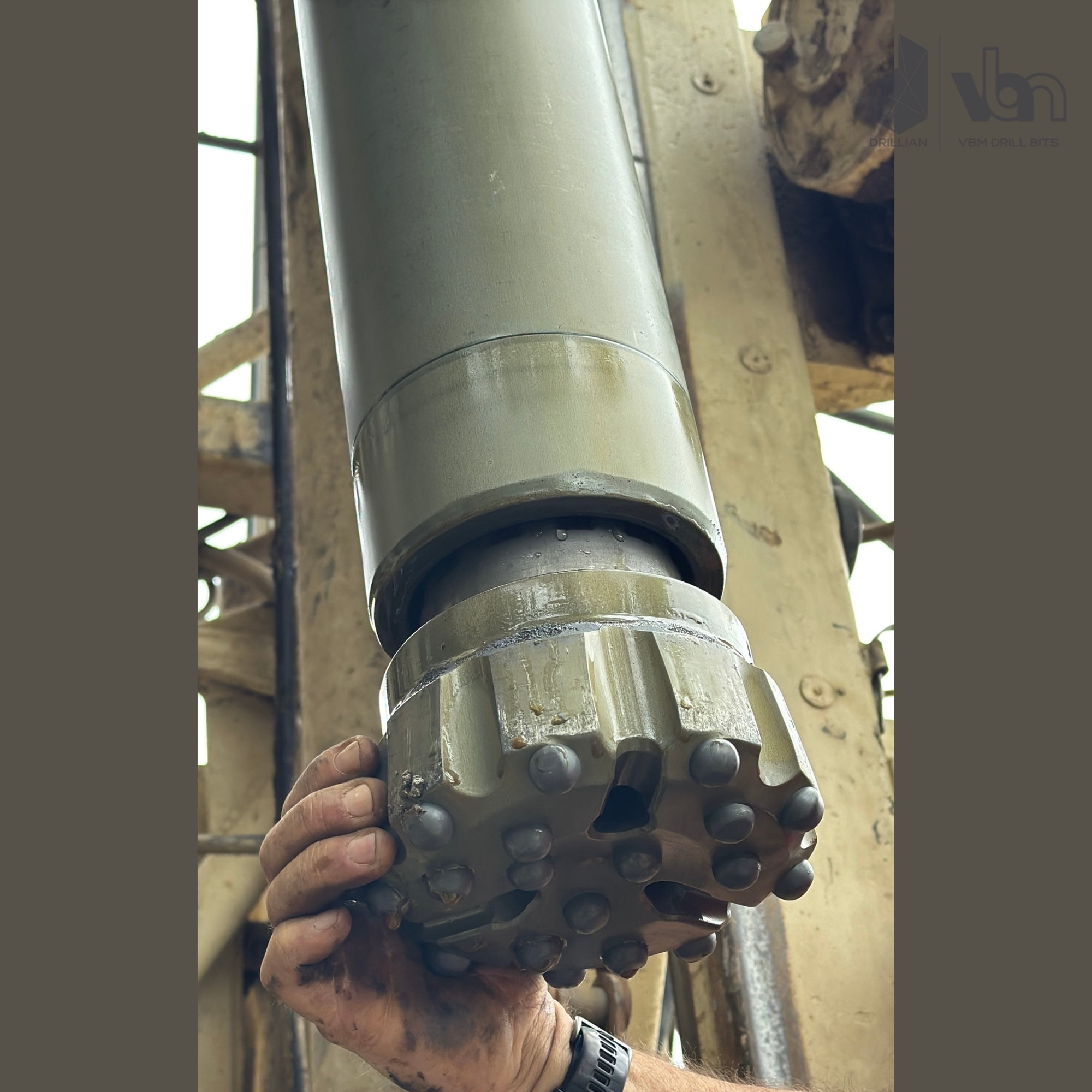
Bit Condition After 450 ft
Penetration rate only tells half the story. A bit that drills fast and comes out destroyed has cost you more than it earned. Here is what the tooling looked like when it was pulled.
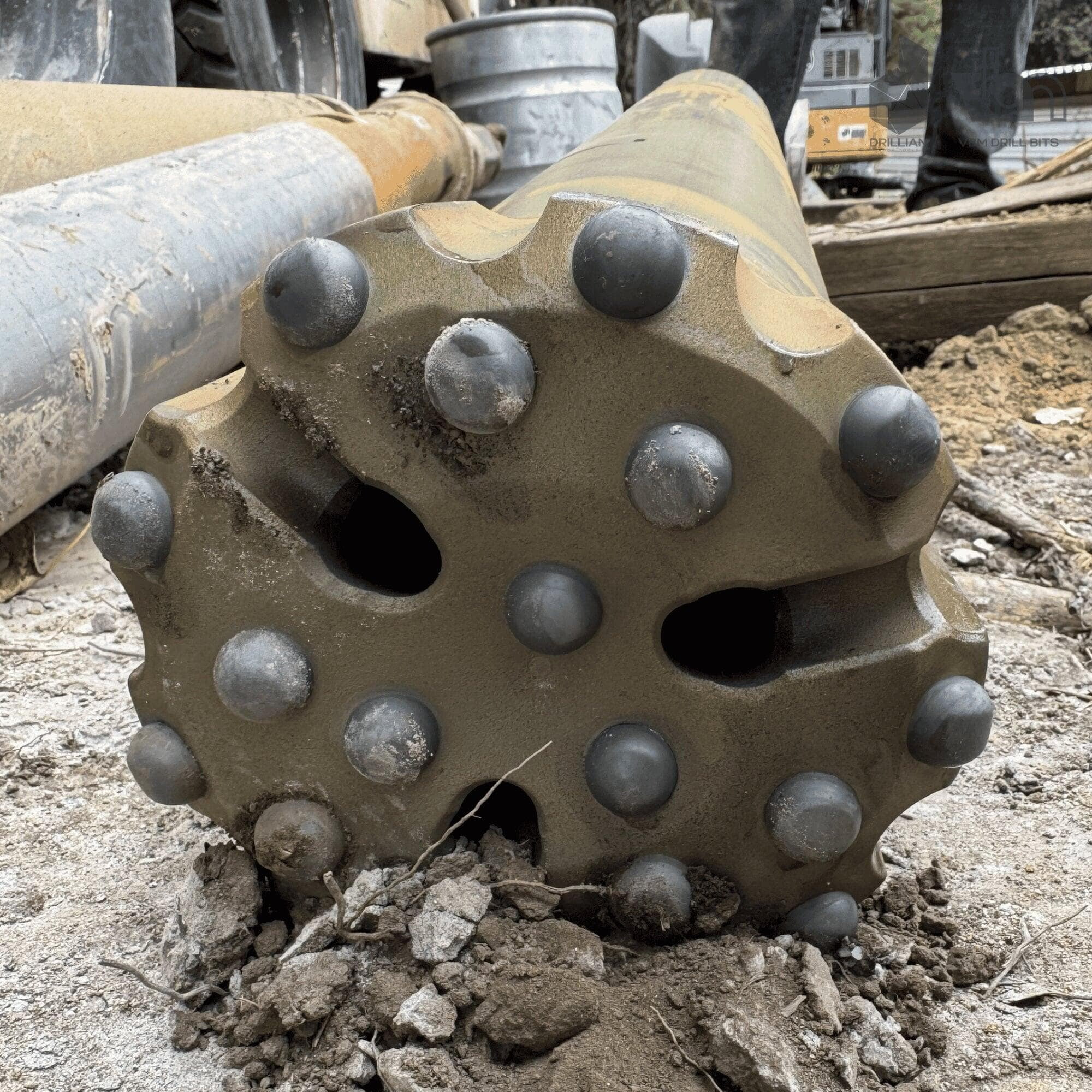
Bit face and M60 shank at ground level after the run. All 18 dome TCI buttons intact across front and gauge rows, 3-port flushing configuration clear, spline drive zone in good condition.
The inspection findings were consistent across both the in-mast view and the ground-level profile:
- Zero insert loss and zero chipping. All 18 dome buttons retained full height across front and gauge rows.
- No gauge reduction. Gauge row buttons showed uniform height, confirming even cutting action and a hole drilled to size top to bottom.
- 7–10% cosmetic body-steel wear. Surface scrape marks only, with no cracking or spalling. Structurally insignificant.
- Clean flushing. Debris around the pulled bit consisted of properly evacuated fine granite cuttings, with no balling or regrinding.
- Serviceable shank. The M60 shank and spline drive zone were in good condition with substantial service life remaining.
A bit in this condition goes back in the hole. That is the point of the exercise: the run demonstrated production rates and durability at the same time, rather than trading one for the other.
Applying This to Your Own Hard Rock Program
Match the shank before anything else
A DTH bit and hammer are a matched pair, not two independent purchases. The shank profile — QL, M, or DHD — determines which bits will fit and drive correctly in a given hammer. Mixing families causes drive-lug damage and poor energy transfer even when the outside diameter looks close. Confirm the shank designation on both parts before ordering. Our full DTH product range lists hammers and bits by shank so they can be specified together.
Choose the face type for the formation
Concave faces centralize the cutting action and help the bit hold a straight line, which is why they suit hard, competent rock like the granite in this test. Flat faces are the general-purpose option and perform well in mixed or medium formations. Convex faces improve penetration in softer or more broken ground but give up some straightness. If your holes need to stay plumb through hard rock, concave is usually the right starting point.
Match insert profile to the wear mechanism
Dome and spherical inserts resist abrasion and chipping, which is what hard, dense rock demands. Ballistic profiles penetrate faster in softer formations but are more exposed to impact damage in crystalline rock. Identify whether your formation kills bits by abrasion or by impact, and select accordingly.
Size your air package honestly
Air volume drives both blow frequency and cuttings evacuation. Undersized air produces slow penetration and, worse, regrinding of cuttings at the face, which accelerates insert wear. Check the hammer's consumption curve against your compressor's sustained output at the pressure you actually run, not its peak rating.
Pro tip: Note that IADC codes do not apply to DTH bits. The IADC classification system was built for roller cone bits and describes cone and bearing configurations that DTH tooling does not have. Specify DTH bits by shank type, diameter, face profile, and button layout instead. For roller cone selection, IADC coding remains the right framework — see our tricone bit range.
Frequently Asked Questions
In medium-hard granite around 10,000–18,000 psi UCS, a properly matched 6¾″ DTH assembly at 600 CFM can sustain roughly 90 ft/hr, as measured on this run. Rates vary with air volume, weight on bit, hole depth, and formation hardness, so treat this as a benchmark for comparable conditions rather than a guarantee.
Only up to the hammer's design limit. Additional air increases blow energy and improves cuttings evacuation until the hammer reaches its rated consumption, after which the extra volume delivers no further gain. On this test the assembly was not yet blow-limited at 600 CFM, which is why raising it to 900 CFM produced a 13% ROP improvement.
Concave is generally the strongest choice for hard, competent formations. It concentrates cutting action toward the center of the face and helps the bit hold a straight line. Flat faces suit mixed and medium ground; convex faces favor penetration rate in softer or fractured formations at some cost to hole straightness.
Watch for rising drilling time per rod at constant air and weight, visible gauge reduction, flat-spotted or missing buttons, and cracking or spalling in the body steel. Cosmetic surface wear on the body is not a reason to retire a bit. Insert loss and gauge wear are.
Yes, and hard rock water well work is one of the strongest applications for DTH. Air hammers cut consolidated rock quickly, produce a straight hole, and evacuate cuttings efficiently, all of which matter when setting casing and completing a well. The run described here was a water well project in granite.
Conclusion
Across 450 ft of medium-hard granite, the M60 hammer and 6¾″ concave dome-button bit held roughly 91 ft/hr at 600 CFM, lifted to 104 ft/hr at 900 CFM, and came out of the hole fully serviceable with no insert damage. For contractors working the granitic and metamorphic formations of Southern California — and comparable hard rock elsewhere in North America — that combination of production rate and retained bit life is what determines project economics.
If you are specifying tooling for a hard rock program, the levers that mattered most here were shank compatibility, concave face geometry, dome insert profile, and an air package sized to what the hammer can actually use. We can help you match all four to your formation.
Ready to Spec Your Hard Rock Tooling?
Browse Products
Explore our full range of DTH hammers, matched by shank type and hole diameter.
Shop DTH HammersRequest a Quote
100+ SKUs stocked in the US, dispatched within 24 hours. Pricing back to you fast.
Get a Free QuoteContact Us
Talk to a drilling specialist about your formation and rig setup.
sales@vbmdrillbits.com+1 (818) 203-8858Related Reading
More on matching DTH tooling to your formation.